

What Does “Genuine Italian Porcelain” Actually Mean?
Genuine Italian porcelain means that the product has a defensible manufacturing origin in Italy, supported by traceable manufacturer, product and commercial information. A tile described as “Italian-style”, “Italian-inspired” or “designed in Italy” is not necessarily the same as porcelain manufactured in Italy.
How Can You Verify Whether Porcelain Tiles Were Made in Italy?
Check the manufacturer, original factory labelling, product and batch codes, technical documentation and written commercial or origin information. No single visual clue should normally be treated as conclusive. The strongest evidence is a consistent chain connecting the product to an identifiable manufacturer and manufacturing origin.
Does an Italian Pallet Mark Prove the Porcelain Was Made in Italy?
No. An ISPM 15 timber mark relates to the treatment and identification of wood packaging, not the manufacturing origin of the porcelain. Pallet markings can provide useful contextual information about the logistics chain, but they should not replace product-level documentation.
Is Italian Porcelain Always Better Than Indian Porcelain?
No. Manufacturing country alone does not determine porcelain quality. Italy has a long-established ceramics industry and strong design reputation, while modern Indian factories can also manufacture technically strong 20 mm outdoor porcelain. Product specification, firing, dimensional control, surface performance and factory quality control are more useful comparisons than nationality alone.
Why Is Porcelain Manufacturing Origin Worth Checking?
Origin matters because it can affect manufacturing cost, supply chain, traceability and the accuracy of premium marketing claims. A buyer paying specifically for genuine Italian manufacture should be able to distinguish that claim from Italian styling, branding or design influence.
Professional buying principle: Verify the product, manufacturer and supporting documentation rather than relying solely on collection names, brand associations or verbal descriptions.
Italian Porcelain in the UK Paving Market
In the UK landscaping and paving market, the phrase “Italian porcelain” is commonly associated with premium design, established ceramic manufacturing and long-standing technical expertise. Italy has a substantial international reputation in ceramic and porcelain production, particularly in surface design, printing and decorative effects.
However, global manufacturing and distribution chains have become increasingly complex. The term “Italian porcelain” can therefore appear in several different commercial contexts.
For buyers comparing current products, sizes and outdoor specifications, the main Porcelain Paving Slabs collection should remain the commercial product destination. This article focuses specifically on manufacturing origin and how that origin can be checked.
Market Insight – Professional Buying Guidance
The UK market for 20 mm porcelain paving, particularly in the 900 × 600 format, is highly competitive and price-sensitive. Based on PSU market observation, Indian-manufactured 20 mm porcelain has commonly occupied a retail band of approximately £19.50–£25.00 per m² including VAT and delivery, although actual prices vary according to specification, pallet coverage, logistics, stock position, retailer structure and after-sales support.
Price alone cannot prove manufacturing origin. However, if a product is promoted specifically as premium Italian manufacture while consistently selling at a price normally associated with high-volume lower-cost production, requesting written origin confirmation is commercially reasonable.
1. What Evidence Supports Genuine Italian Manufacture?
Where a paving product is presented as genuinely Italian-manufactured, there should be a traceable basis for that claim.
Useful evidence can include:
- an identifiable manufacturing company in Italy;
- manufacturer name and address;
- original factory packaging;
- product codes and batch identification;
- commercial documentation consistent with the claimed origin;
- technical documentation traceable to the actual product and manufacturer.
Important: Country-of-origin rules can become technically complex when production involves materials or manufacturing stages in more than one country. A retailer or buyer should not invent their own legal origin test. For normal procurement, the practical requirement is that a “Made in Italy” claim should be supported by coherent manufacturing and commercial evidence.
If a product is described as Italian-style, Italian-inspired or designed in Italy, that wording should be distinguished from an explicit claim that the porcelain itself was manufactured in Italy.
2. Why Can Italian and Indian 20 mm Porcelain Have Different Cost Structures?
Porcelain manufacturing is both energy-intensive and capital-intensive. Different industrial cost structures help explain why genuine Italian and Indian outdoor porcelain can occupy different positions in the UK market.
2.1 Energy and Labour
- Italian factories operate within a European industrial cost structure with comparatively high labour and energy costs.
- Indian manufacturing clusters can benefit from lower structural labour costs and substantial export-production scale.
2.2 Scale and Market Positioning
India has developed large export-focused porcelain manufacturing centres capable of producing significant quantities of 20 mm outdoor slabs for the UK and other international markets.
Italian manufacturers also operate highly advanced production facilities, but many established Italian ranges occupy a different design, brand and price position.
This does not mean retail price identifies origin. It means that unusual pricing can justify further verification when country of manufacture is a central part of the sales proposition.
The popular 900 × 600 porcelain paving format is produced by manufacturers in several countries, so size itself provides no reliable indication of origin.
3. Marketing Language: Made in Italy, Italian-Style and Designed in Italy
UK product descriptions can use several similar-looking phrases:
- Made in Italy
- Italian porcelain
- Italian-style porcelain
- Italian-inspired design
- Designed in Italy
- European quality
These descriptions should not automatically be treated as equivalent.
Made in Italy is an origin statement. By contrast, Italian-inspired normally describes appearance or design influence, while designed in Italy may refer to design activity without establishing where the porcelain body was manufactured.
The shorter expression Italian porcelain can be less precise in ordinary marketing usage, which is why product-level information matters.
3.1 Mixed-Origin Collections
A retailer may group products manufactured in different countries within one broad collection, design family or merchandising category.
For example, genuinely Italian-manufactured porcelain and products manufactured in India or elsewhere may appear within the same general colour or style category.
There is nothing inherently wrong with a mixed-origin range provided individual products are accurately described. Buyers should therefore inspect the product specification rather than assume every item under a collection title shares the same manufacturing origin.
4. How to Check Whether Porcelain Is Genuinely Italian-Made
4.1 Check Original Factory Packaging
Original cartons and pallet labels can contain useful identification such as:
- manufacturer;
- factory or business address;
- product code;
- batch or shade code;
- calibre;
- country-of-origin wording;
- technical classifications.
Where a product is explicitly sold as Italian-made, consistent original factory information provides useful supporting evidence.
4.2 Check Manufacturer and Product Traceability
An established manufacturer should normally be identifiable independently of the UK distributor or retailer.
Useful questions include:
- Who manufactured the porcelain?
- Where is the factory?
- Does the product code correspond with the manufacturer's range?
- Is the technical documentation traceable to the same product?
- Can the production batch or shade be identified?
4.3 Check Commercial or Import Documentation
Written supplier confirmation, commercial invoices and relevant customs or origin documentation can provide stronger evidence than verbal assurances alone.
For substantial trade or commercial purchases, requesting written product-level origin confirmation is normal procurement practice.
5. What Can ISPM 15 Timber Marks Actually Tell You?
Timber pallets and other wood packaging used in international trade can carry an ISPM 15 treatment mark.


An ISPM 15 mark does not prove the manufacturing origin of the porcelain. It relates to the treatment and identification of the timber packaging. It can provide contextual information about the pallet or logistics chain, but it should not replace product or commercial documentation.
5.1 Examples of Indian Timber Packaging Marks

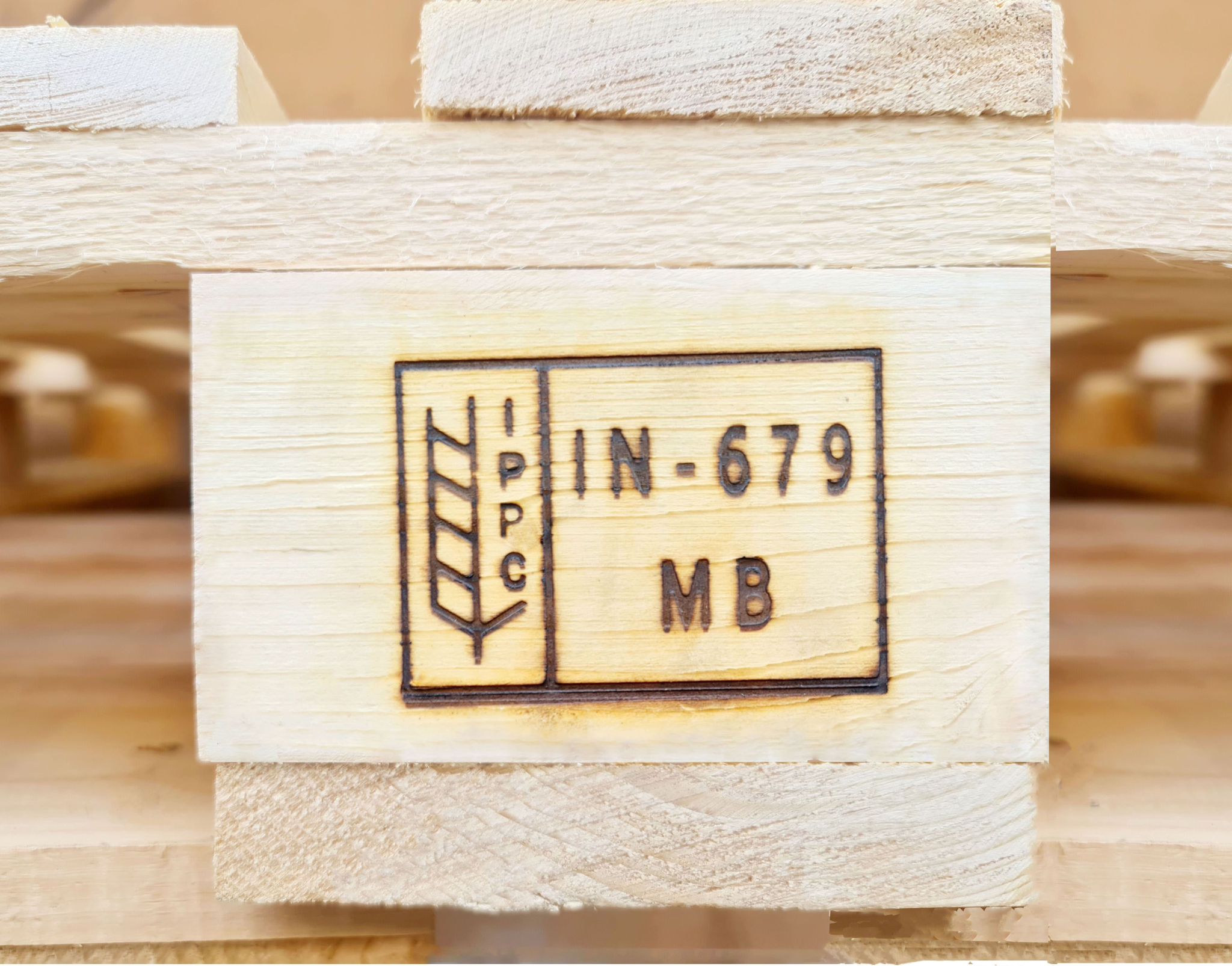

Importers may retain original export pallets because replacing them adds handling, labour and potential breakage. Original pallet markings can therefore provide contextual clues about the shipping chain.
However, the same limitation applies: the timber mark is not legal or technical proof of where the porcelain itself was manufactured.
6. Can Porcelain Packaging Change After Import?
Yes. Packaging can be damaged, replaced, consolidated or altered during warehousing and distribution. Pallets can also be rebuilt after transit damage.
This is another reason packaging should be treated as supporting evidence rather than the sole origin test.
A stronger verification combines:
- factory identity;
- product code;
- original labels where available;
- batch identification;
- technical documentation;
- commercial documentation;
- written supplier confirmation.
7. Does Italian Manufacture Automatically Mean Higher Quality?
No. Manufacturing origin alone does not determine quality.
Italy has an established international ceramics industry with substantial expertise in design, printing, glazing, surface development and ceramic manufacturing technology. India also has modern export-focused factories capable of manufacturing durable 20 mm exterior porcelain.
The more useful comparison is the actual product specification and production consistency.
Relevant factors include:
- water absorption;
- vitrification and firing consistency;
- dimensional accuracy;
- surface quality;
- slip performance;
- mechanical performance;
- graphic face variation;
- batch consistency;
- factory quality control.
For a deeper explanation of manufacturing, vitrification, testing and batch inspection, see How Porcelain Paving Is Made: Manufacturing, Quality Tests & UK Supply.
8. Should Italian and Indian Porcelain Be Compared on Price Alone?
No. A useful comparison separates origin, specification, design, manufacturing consistency and retail structure.
A lower-cost Indian-manufactured slab can provide strong value when its technical specification and quality control are appropriate. A higher-priced Italian product can justify a premium through surface development, manufacturer reputation, technical specification or specialist design.
Price by itself should not be used as proof of either origin or quality.
Buyers wanting a broader specification checklist should see the Outdoor Porcelain Paving Buying Guide.
9. What Should Professional Buyers Ask the Supplier?
For a substantial order, a short verification checklist can remove much of the uncertainty:
- Who manufactures this product?
- In which country is it manufactured?
- Is the claim “Made in Italy” or only “Italian-inspired”?
- Can the factory or manufacturer be identified?
- Is original factory packaging available?
- Can the batch or shade code be confirmed?
- Is product-specific technical documentation available?
- Can written confirmation of manufacturing origin be supplied?
A professional supplier should be able to distinguish clearly between design language and manufacturing-origin claims.
10. Balanced Industry Perspective
Italian porcelain has a respected position within the international ceramics industry, but accurate origin representation matters more than nationality-based assumptions about quality.
- Premium pricing is legitimate.
- Premium branding is legitimate.
- Italian design influence is legitimate.
- Indian manufacture is legitimate.
- Mixed-origin product ranges are legitimate when accurately described.
- Manufacturing origin should be represented clearly and consistently.
The objective is not to argue that one manufacturing country is automatically superior. It is to ensure that buyers understand what they are purchasing and can compare products on an equivalent basis.
For customers comparing porcelain with other patio materials rather than manufacturing countries, the wider Paving Slabs range provides the appropriate commercial starting point.
Italian Porcelain Origin FAQs
Does “designed in Italy” mean the porcelain was made in Italy?
No. “Designed in Italy” describes where design work may have taken place. It does not by itself establish that the porcelain was manufactured in Italy.
Can a UK retailer sell Italian and Indian porcelain in the same collection?
Yes. A collection can contain products from several manufacturing countries. The important point is that individual products should be described accurately enough for buyers to understand their actual manufacturing origin.
Is price enough to prove that porcelain is Italian-made?
No. Price can reflect manufacturing costs, branding, design, distribution and retailer positioning, but it cannot prove country of origin. Product and commercial documentation provide stronger evidence.
Can pallet packaging be changed after the porcelain reaches the UK?
Yes. Pallets and packaging can be damaged, replaced or rebuilt during transport and warehousing. Packaging is therefore useful supporting evidence but should not be the only origin check.
What is the strongest practical evidence of manufacturing origin?
A consistent combination of identifiable manufacturer information, product and batch codes, original factory documentation, commercial records and written supplier confirmation provides much stronger evidence than branding or pallet markings alone.
Should a supplier confirm manufacturing origin in writing?
Where country of manufacture is being used as a material selling point, requesting written product-level confirmation is reasonable, particularly for substantial or professional purchases.


