

How does granite paving travel from a quarry to a UK customer?
Granite paving moves through a controlled chain of quarry selection, block inspection, factory cutting, surface finishing, dimensional checks, packing, container shipping, UK warehousing and final delivery. Each stage affects the finished product. A durable stone can still become unsuitable if it is cut inaccurately, given the wrong finish, mixed carelessly between batches or packed in weak crates.
What makes a granite block suitable for paving products?
A suitable block must have the colour, mineral structure, soundness and workable dimensions required for the intended product. The factory must also consider natural veins, fissures, mineral concentrations and consistency across the usable faces. The correct selection criteria differ for paving slabs, thick steps, long kerbs and small-format setts.
How are granite paving slabs manufactured?
Granite blocks are sawn into sections, cut to the required plan size and thickness, finished for outdoor use, checked and packed. Depending on the specification, production may include calibration, flaming, shot blasting, sandblasting, brushing, chamfering or bullnosing. The finish must be suitable for the intended location rather than selected only for appearance.
What quality checks should happen before granite is shipped?
Checks should cover dimensions, thickness, squareness, surface finish, edge condition, visible variation, quantity, labelling and crate strength before container loading. For contract or public-realm work, the supplier should also confirm the required product standard, declared performance and project specification instead of assuming that one test result applies to every granite.
Why does quarry and factory knowledge matter to UK buyers?
Quarry and factory knowledge helps a UK supplier specify the right stone, finish and format before problems become embedded in a shipment. It also supports clearer advice about natural variation, batch matching, tolerances, packing, intended use and realistic replenishment times.
Granite Supply Starts with the Quarry
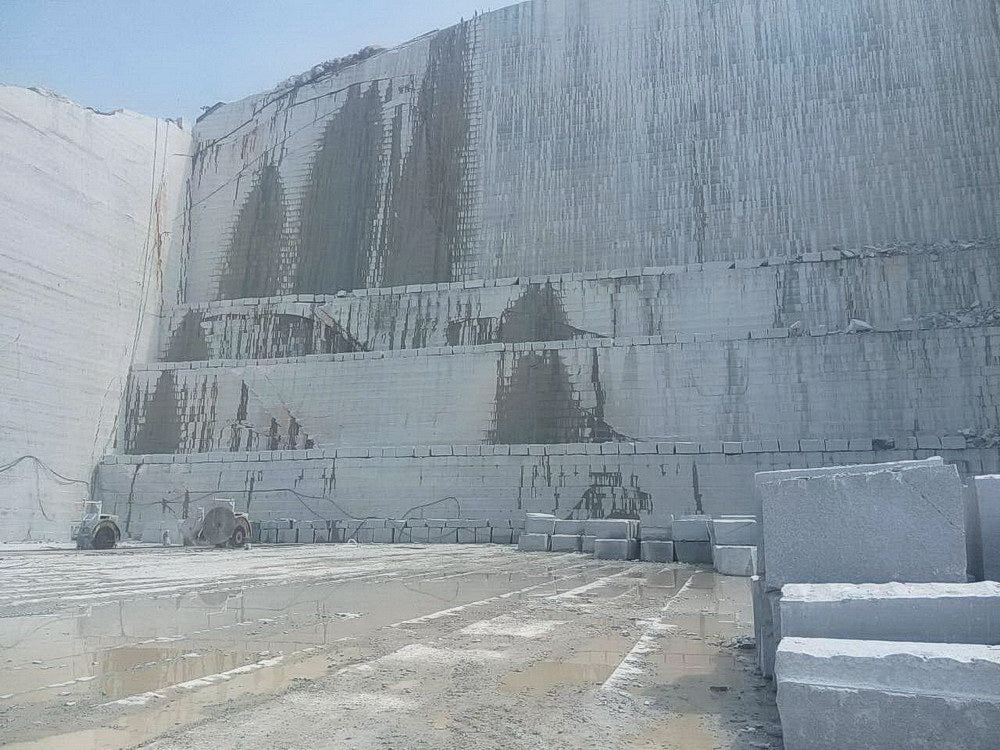
Granite paving starts as natural rock, not as a uniform factory-made sheet. Even within one commercial colour, different quarry faces or extraction periods can show movement in tone, crystal size, mineral markings and grain. These variations may be acceptable natural characteristics, but they still need to be understood when planning a consistent production batch.
Initial selection considers more than colour. A block must be large and sound enough for the intended format. Long kerbs and thick steps impose different demands from 900 x 600 mm paving slabs, while setts can often be produced from smaller sections. Matching each block to the product helps improve yield without lowering the required specification.
What is checked during block selection?
- The commercial colour and likely variation across the block.
- Grain and visible mineral distribution.
- Natural fissures, veins or structural weaknesses that could affect cutting.
- Block dimensions and usable yield for slabs, steps, kerbs or setts.
- Compatibility with the required surface and edge finish.
How Factory Cutting Defines the Finished Product
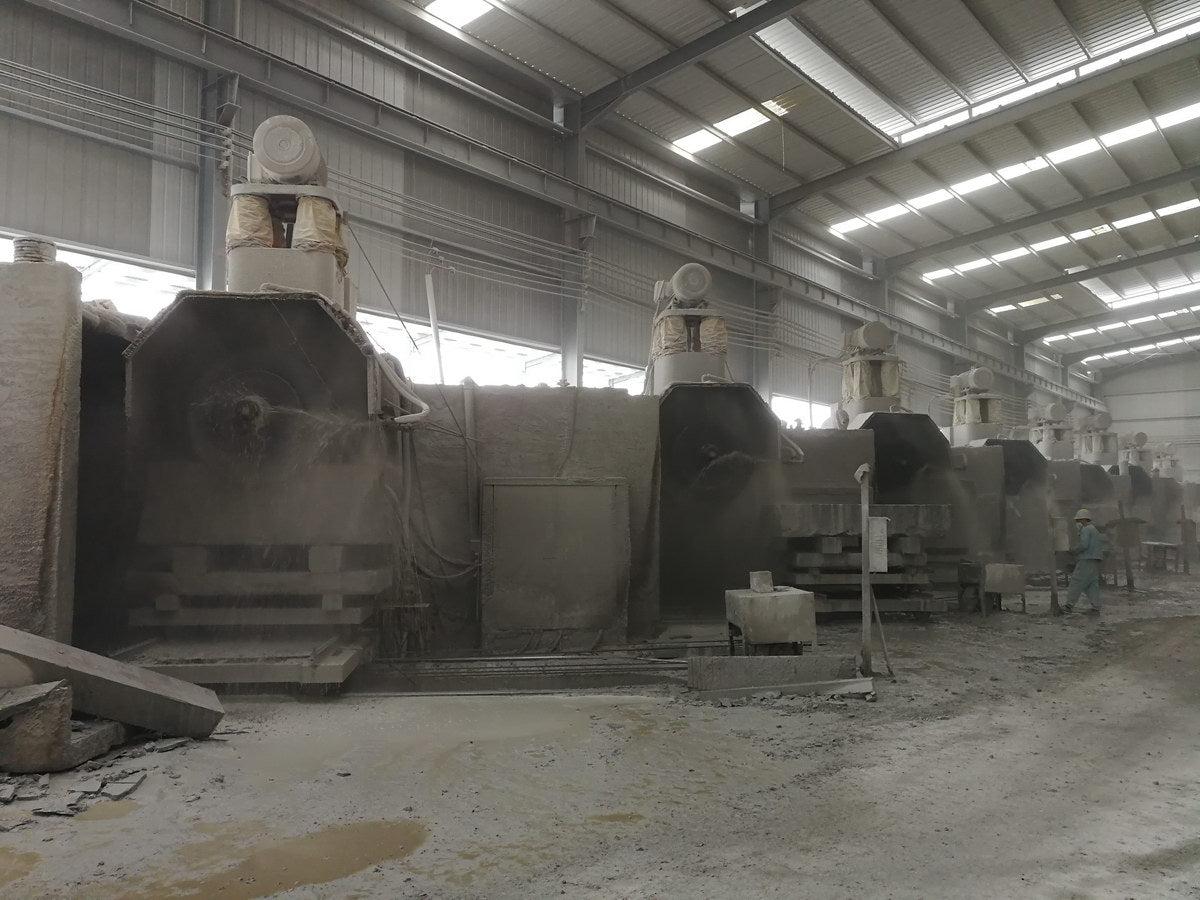
After quarry extraction, selected blocks are transported to a stone factory for primary sawing. The resulting sections are then cut to the specified length and width. For calibrated paving, further processing controls the nominal thickness and helps the installer form a more consistent mortar bed.
Cutting accuracy affects joint alignment, laying speed and the appearance of the finished surface. Checks should therefore consider more than whether a slab is nominally described as 900 x 600 mm. Squareness, dimensional tolerances, thickness range and edge condition all influence how the batch performs on site.
Why Surface Finishing Matters for Outdoor Granite
A freshly sawn granite face is not automatically the correct finish for every external paving application. Outdoor products are commonly textured to change their appearance and surface characteristics. Flaming uses controlled heat to fracture the upper mineral surface and create a textured face. Shot-blasted, sandblasted and brushed finishes produce different visual and tactile results.
The finish must be assessed on the actual granite and for the intended use. Colour, texture and slip performance can change with the stone, finishing method, production control, weathering and site conditions. Descriptions such as “flamed” or “shot-blasted” are useful, but they are not substitutes for product-specific data where a project requires declared performance.
Important: Do not assume that every granite with the same commercial colour name has identical strength, water absorption or slip resistance. Technical values must relate to the specified stone and product, while the correct slab or sett thickness must be selected for the unit size, bedding system, expected loading and overall pavement design.
Why Different Granite Products Need Different Production Controls
Granite is used across a wide hard-landscaping family, but each format presents a different manufacturing challenge:
- Paving slabs: plan size, squareness, thickness and an appropriate walking surface are central checks.
- Steps: thicker sections, front-edge processing, tread finish and visible-face consistency require closer control.
- Setts: size range, split or sawn faces, pack mix and quantity accuracy affect laying and pattern formation.
- Kerbs and edging: length, section profile, straightness and edge finish matter for alignment and restraint.
- Coping: width, thickness, edge treatment and water-shedding detail must suit the wall design.
Natural stone slabs, setts and kerbs are distinct product forms. Where relevant to the market and project, specifications may refer respectively to BS EN 1341, BS EN 1342 and BS EN 1343. The applicable documentation and performance requirements should be confirmed for the actual supply rather than inferred from another product in the same granite range.

Granite Colours and Formats for UK Projects
Our main granite paving range covers different colours, formats and intended uses rather than one universal slab specification.
For light contemporary schemes, Silver Grey Granite Paving offers a pale grey background with natural crystalline variation. Blue Grey Granite Paving provides a deeper grey appearance, while Glacier Ice Granite Paving gives a cooler and more varied visual character.
Darker designs can use Absolute Black Granite Paving. Warmer schemes may suit Yellow Brown Granite Paving or Rose Pink Granite Paving. These are commercial colour groups; photographs and samples should not be treated as a guarantee that every piece will be identical.
Beyond patio slabs, Granite Steps address level changes and entrances. Granite Kerbs and Blocks provide edge restraint and structural detailing, while Granite Paving Setts and Cobbles suit borders, paths and properly designed driveway construction. Granite Coping and Edging complete steps, walls and boundaries.
Customers comparing common pedestrian paving formats can review Granite Paving Slabs 20mm. Suitability still depends on unit size, intended loading and the complete installation design. The Grey Granite Paving range provides a broader colour-led route, while Council Granite Paving covers heavier and public-realm project requirements.
Quality Control During Production
Quality control should be staged throughout production rather than left until the crates are ready to close. Early checks can identify the wrong block, excessive variation or processing problems before the whole order is completed. Later checks confirm the finished specification and packing list.
A practical factory inspection sequence
- Material approval: compare the production stone with the agreed colour and character range.
- First-off inspection: check initial cut sizes, thickness and finish before full production.
- In-process checks: monitor calibration, surface consistency, edge processing and visible defects.
- Pre-packing inspection: verify quantities, formats, acceptable variation and damaged pieces.
- Packing inspection: check crate construction, internal restraint, labelling and pack identification.
- Loading control: reconcile crate numbers and weights with the shipment documents.
Why Packing Is Part of Product Quality
Granite is hard and durable in service, but individual pieces can still chip or break during handling. Heavy contents place substantial loads on the crate base, bearers, sides and straps. Slabs must also be restrained so that movement inside the crate does not damage edges and visible faces.
Packing must account for the full route: movement inside the factory, container loading, sea transit, unloading, UK warehouse handling and pallet delivery. A visually acceptable factory batch can become a poor customer delivery if its packaging is not designed for those stages.
From Export Container to UK Warehouse Stock
Once production and packing are complete, crates are assigned to the shipment, weighed and loaded in accordance with the container plan. Accurate pack lists and product labels help the UK warehouse identify the range, size, batch and quantity after arrival.
UK stockholding reduces the delay between an individual customer order and delivery, but it does not remove the need for forward planning. Granite replenishment includes factory scheduling, inspection, export documentation, container availability, sea transit and port handling. Special sizes, low-volume colours and matching processed pieces may require longer lead times than standard slabs.
Project planning: Reserve matching paving, steps, setts, kerbs and coping together where appearance matters. A later production batch may show a legitimate difference in tone, grain or surface finish.
How Natural Variation Should Be Managed
Natural colour movement, crystalline grain, mineral markings and occasional veins are part of real granite. Quality control should manage the agreed range and remove pieces that fall outside the specification; it should not create the false expectation of a printed, completely uniform surface.
For projects where close visual consistency is important, the practical approach is to approve the range, order the full quantity together and blend pieces from several crates during laying. Samples show the general material and finish, but a small sample cannot display every feature in a full production batch.
What UK Buyers Should Confirm Before Ordering
- The exact product, colour, dimensions, nominal thickness and surface finish.
- Whether the format is suitable for the intended pedestrian, domestic vehicle or commercial loading.
- Current physical UK stock and whether matching steps or edging are available.
- The expected range of natural colour and grain variation.
- Pack coverage, quantities and a suitable allowance for cutting and selection.
- The planned base, full mortar-bed, slurry-primer, drainage and jointing specification.
- Any project-specific testing, declaration or product-standard requirements.
Installation boundary: Factory quality cannot compensate for an unsuitable pavement design. Granite slabs should not be spot-bedded. The installer must provide the correct excavation and compacted base, adequate falls and drainage, a continuous full mortar bed, suitable slurry primer on the underside and an external jointing system appropriate to the project.
How Paving Slabs UK Connects Production with UK Supply
Our experience covers block selection, factory processing, product specification, packing and export control as well as UK stock and customer delivery. The purpose of this connection is practical: to identify production risks earlier, describe natural stone more accurately and select products that meet real landscaping requirements.
Customers can also review our granite quarry and factory background for more information about the source and production side of the range.
A dependable granite supply chain is not defined by the cheapest factory quotation. It depends on an appropriate stone source, a clear specification, controlled manufacturing, robust packing, accurate documentation and realistic UK stock planning. When those stages work together, granite can provide the consistent product range required for patios, paths, steps, driveways and public-realm landscaping.
Granite Quarry, Production and UK Supply Questions
Can one granite block be used for every paving product?
No. The block must be assessed for soundness, dimensions, colour and structure against the intended product. A block suitable for small setts may not provide the size or consistency required for long kerbs, large slabs or thick steps.
Does a flamed surface make every granite equally slip resistant?
No. Flaming creates a textured surface, but slip performance still depends on the particular granite, production control, surface condition, contamination, weathering and test method. Use product-specific data where a project has a defined slip requirement.
Why should granite be inspected before the full order is produced?
An initial material and first-off inspection can identify an unsuitable colour range, incorrect dimensions or the wrong finish before the issue is repeated across the whole production batch.
Can a small granite sample show the complete delivered colour range?
No. A sample is useful for showing the general stone and finish, but natural granite varies across blocks and production batches. Full orders should be assessed as a natural range and blended from several crates during installation.
Why should matching granite products be ordered together?
Ordering paving, steps, setts, kerbs and coping together improves the chance of securing compatible production batches. Later stock may differ legitimately in tone, mineral pattern or surface appearance.
Which standards cover natural stone slabs, setts and kerbs?
Natural stone slabs, setts and kerbs for external paving are covered respectively by BS EN 1341, BS EN 1342 and BS EN 1343 where those standards apply. Project specifications should identify the required product form, performance and supporting documentation.
Does strong granite still need careful packing?
Yes. Granite is durable in service, but heavy individual pieces can chip or break through movement, impact, weak crate construction or poor handling during factory transport, container shipping, warehousing and final delivery.


